The past projects, programming and publications listed below engage the question in Lines of Inquiry 1, part of The Blackwood Index on Campus lightbox series. Prompted by the corresponding graphs on the Index, this selection of work exemplifies points of interaction within the Blackwood's ongoing programs. Together, these artists, writers and researchers attune us to the outgrowths, demands, and curiosities that the inquiries provoke.
Related Programs
Steven Eastwood, The Interval and the Instant, 2018
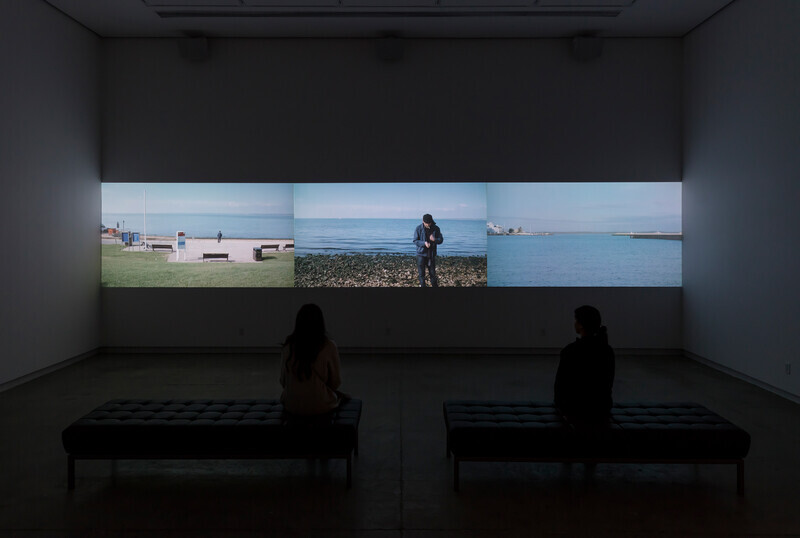
An intimate and patient encounter with the end of life in the context of palliative care, The Interval and the Instant is a multiscreen video installation that reworks footage from Steven Eastwood’s feature-length film, Island (2017), a sustained engagement with four individuals navigating terminal diagnoses in a hospice on the Isle of Wight in England. Filmed over twelve months, Island is a life-affirming reflection on dying, portraying the transition away from active personhood and observing the last days of life and the moment of death. Based on extraordinary access to intensely private events, Island shows diagnosis, treatment, the progression of illness, and death—trialling, in the process, an ethics of looking at dying.
Paul Maheke, Mutual Survival, Lorde’s Manifesto, 2015
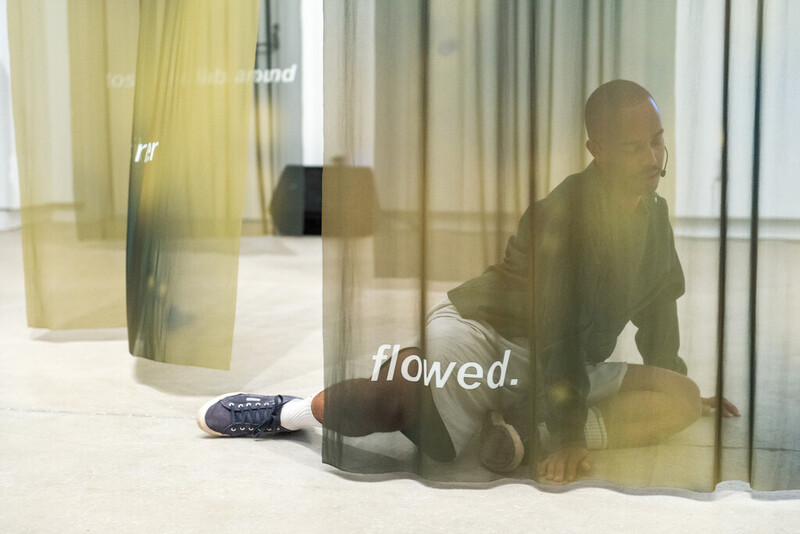
Paul Maheke’s work evokes the political dimensions of self and collective care, fragility, and sustenance. As Habits of Care curator Helena Reckitt explains, “the video diptych in Mutual Survival, Lorde’s Manifesto (2015) juxtaposes two forms of dance, both filmed in the same East London community centre. As the title suggests, the piece also pays homage to the late black feminist writer Audre Lorde. In subtitles drawn from Lorde’s writings, selfcare is described as a practice of decolonization and feminist emancipation. A subwoofer placed on the floor across from the flat-screen monitors resonates in the visitor’s own body.” Paul Makehe’s performance titled Seeking After the Fully Grown Dancer *deep within* initiates an authentic embodied dialogue with his audience. Following principles of Authentic Movement—including closing his eyes, engaging in mindfulness, and trying to move un-self-consciously in the presence of a witness— Makehe creates a unique performance that draws authenticity from spontaneity.
Yehuda Duenyas, John Paul Ricco, Erin Robinsong, Erotic Edges, Queer Intimacy, Wet Dreams, 2024
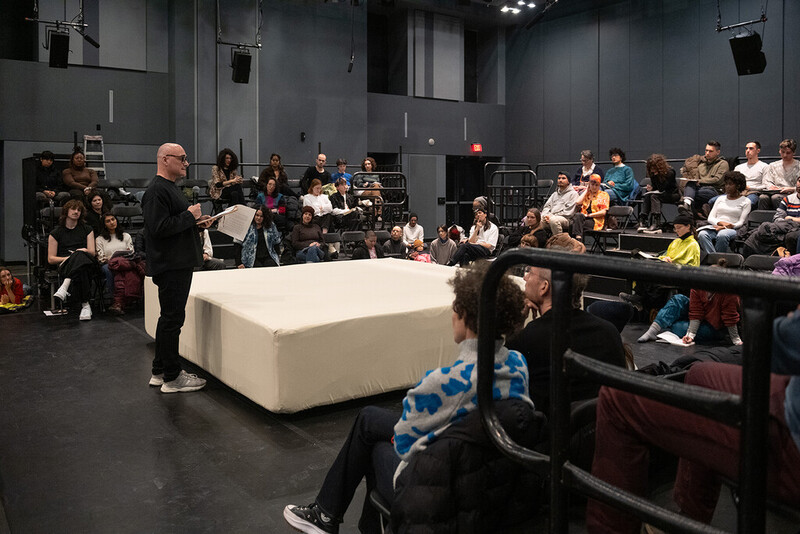
Do nerves, rivers, skies, spit, dreams, drool, and language separate or bind us? If scenes of intimacy are spaces of sharing, are they also spaces of separation? How can we attend to ethical dispositions, erotic edges, and aesthetic commitments to the world and those with whom we share it? How are the ethical and political being redefined by queer conceptions of intimacy and sex ecologies? As the earth’s resources are depleted and bodies are spent, how is our overflowing expressed? Is the future of our wet dreams to be realized at or beyond the edges of what is already known? How do the performing arts reconsider the intimacy between touching and trusting and knowing, and what is accounted for in that reconsideration? What can be learned or unlearned from intimacy coordination and choreography for new ways of acting, living, sensing, and thinking in this world? Erotic Edges, Queer Intimacy, Wet Dreams was part of The Attunement Sessions, a series of artistic provocations, thought-experiments, and experiential exercises that foregrounded the necessity for deeper attunement to the processes of destruction and disaster making the world as we know it (accumulation, alienation, contamination, disembodiment, displacement, extinction, extraction, settlement...) and forms of composing and imagining the future we want to live in (affinities, edgings, interdependencies, proximities, solarities, wet dreams…).
Tania Candiani, Four Industries, 2020
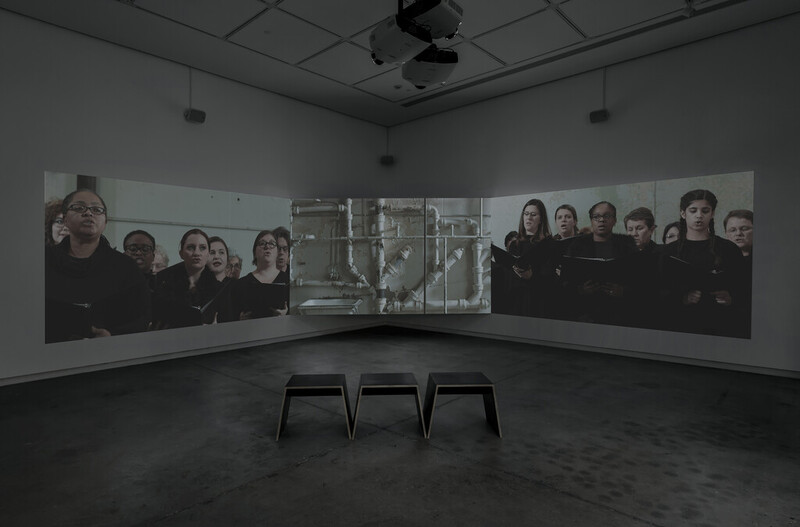
Four Industries is a three-channel film where an all-female choir recites sounds associated with Cincinnati’s major industries of the late 19th and early 20th centuries: metal casting, meatpacking, printing, and woodworking. Filmed in a historic brewery in Over-the-Rhine, the resulting a cappella chorus is rhythmic and repetitive, recalling the pouring, pounding, cutting, and hammering associated with the manufacturing of goods. By using the human voice to emulate mechanized sounds, Tania Candiani reminds us of the corporeal impact of labour—the bodies that were required to support the processing of raw materials during America’s Industrial Revolution.
Accessibility
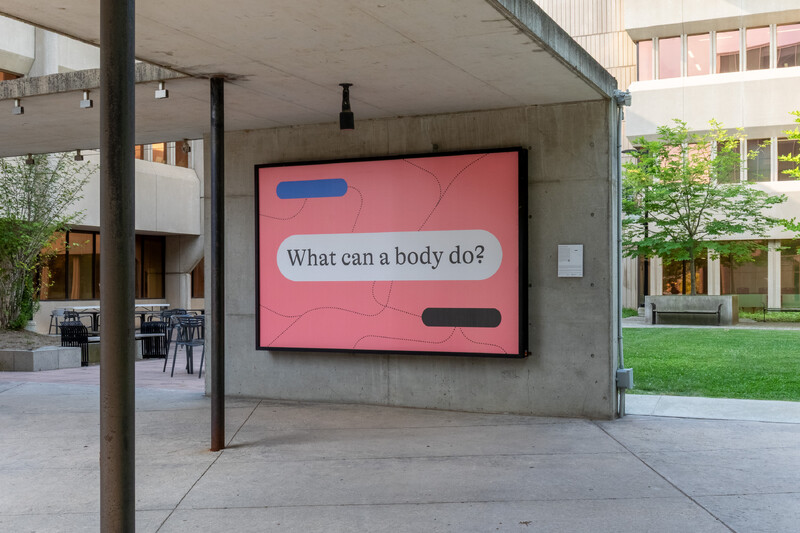
The Blackwood Index on Campus is presented on four outdoor lightboxes in public spaces across the UTM campus. Some movement throughout the campus is required—ramps and curb cuts are in place.
Download a printable map for your visit.
Acknowledgements
The Blackwood gratefully acknowledges the support of the University of Toronto Mississauga, Canada Council for the Arts, and the Ontario Arts Council.

Lines of Inquiry 1
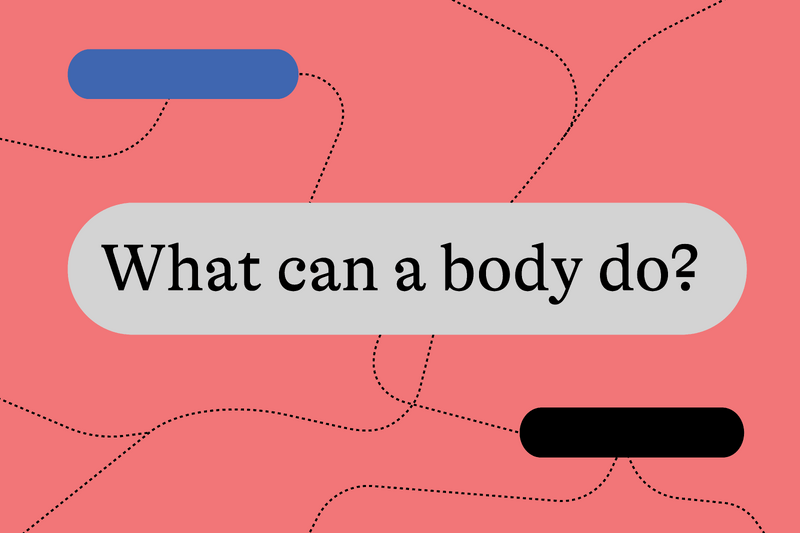
What can a body do?
This question was first posed by 17th century philosopher Baruch Spinoza to consider how thought and action are intertwined through the body’s power to act, to be acted upon, to affect others and to be affected. More recently, Gilles Deleuze readopted Spinoza’s question to assert that we still don’t know what a body can do: not only its physiology, but its capacity for inquiry, relationality, and creativity. In again re-posing this question, we expand its focus beyond the singular: a body encompasses bodies as collective entities, and non-human bodies. In spite of the many ways modernity imposes bodily alienation—through the mechanization of work, or hyper-individualization, for example—the body remains a confounding and elusive organism. Our bodies have wants and needs that make them irreducible to bounded and linear thought. Creative inquiry provides a means to riff and reframe Spinoza’s simple yet expansive question, spiraling it out into related ones: What counts as a body? Where do bodies’ desires and capacities lead? How do we understand non-human bodies? What can’t a body do?
Beginning in summer 2025, The Blackwood poses a series of questions across the four UTM campus lightboxes. These inquiries come at an inflection point: derived from the past ten years of programming led by Director/Curator Christine Shaw, they re-enliven institutional history to carry questions from our past into the future. In doing so, many have been edited to reflect what we’ve learned, and what we hope a question can provoke. Posed alone and in groupings, these questions reflect the scope of open-ended inquiry across multi-year programming.
Visit the Blackwood's Index to see an interactive graph which addresses this question through The Blackwood’s programs.
The Blackwood
University of Toronto Mississauga
3359 Mississauga Road
Mississauga, ON L5L 1C6
[email protected]
(905) 828-3789
The galleries are open. Hours of operation: Monday–Saturday, 12–5pm.
Facebook | Twitter | Instagram
Sign up to receive our newsletter.
The Blackwood is situated on the Territory of the Mississaugas of the Credit, Seneca, and Huron-Wendat.